Grand River Steelhead Fishing: Ontario’s Grand River
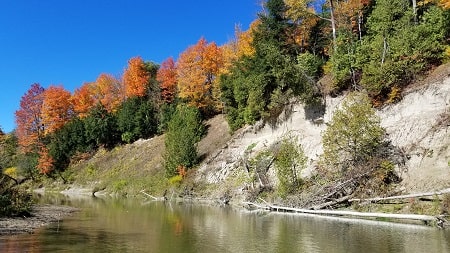
I live about 10 minutes from the Upper Grand River so it’s a river I know extremely well. The Grand River steelhead fishing section starts around the town of Paris, Ontario and runs all the way down to the mouth at Lake Erie. The Grand is already well known as one of the best brown trout rivers in Eastern Canada, but over the past two decades it has become one of the best wild steelhead fisheries on the Canadian side of the Great Lakes.
Anglers from all over Ontario and the USA come to the Lower Grand River to catch big wild steelhead on a fairly large river that suits just about every fishing method. Some of my guide friends and I have been fishing and guiding this river for over 20 years, and we have watched it go from a handful of steelhead to a truly great steelhead fishery.
Whether you are from Ontario or the USA, if you like to fish for strong wild steelhead on larger rivers, you need to check out the Grand River. Most fishing methods work here, there is plenty of room to fish, and this guide covers where to access it, when to go, the section-by-section regulations, and the methods that put me into fish.
The Grand River Steelhead
The Grand River is Lake Erie’s largest Ontario tributary, and its steelhead run has grown steadily into one of the best on the Canadian side of the Great Lakes. These are primarily wild fish, with a few stray hatchery fish that wander over from the U.S. stocking programs on the American side of Lake Erie.
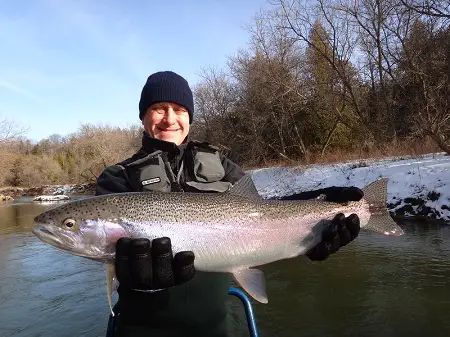
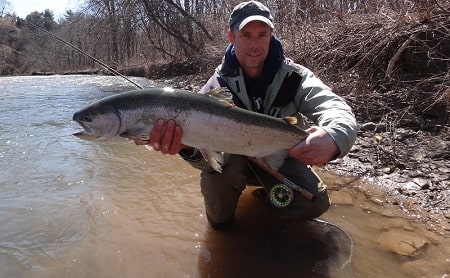
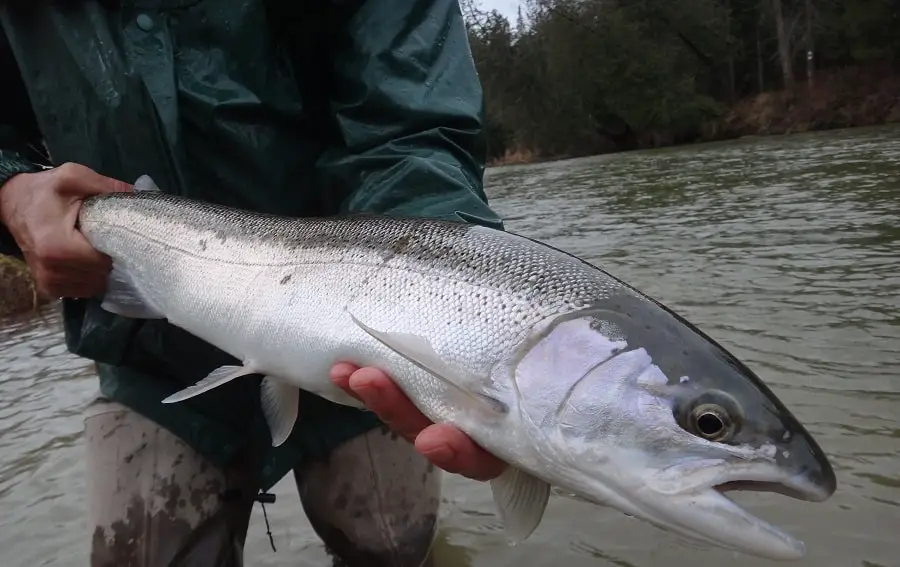
Unlike stocked fish, the wild steelhead of the Grand are known for exceptional strength and stamina. That is exactly why so many of us love fishing for them. Some fish spawn two to three times over a ten-year lifespan, and mature repeat spawners regularly top 15 pounds. A fresh fish straight out of the lake is bright silver with black spots and a pink or red stripe down its side.
There is one more thing that makes this fishery special. A dam in the lower river acts as a natural selection barrier, and only the strongest, most athletic wild fish can pass it. Over time that has concentrated exceptional genetics in the upper part of the run, while most of the hatchery strays that follow the wild fish up from Lake Erie get filtered out below. The result is that above that dam you are fishing to some of the hardest-fighting steelhead in southern Ontario.
How Far Upstream Can Steelhead Go?
Steelhead enter the Grand River from Lake Erie at Port Maitland and push upstream, and they can potentially reach roughly 140 kilometres into the river system and its tributaries. The practical upper limit on the main stem, though, is set by the dams.
Penman’s Dam in Paris is the confirmed upstream barrier on the main Grand. It is a low-head dam on Willow Street, the Ontario regulations reference it as a boundary point, and the Grand River Conservation Authority lists it as a mandatory portage. Fish simply cannot continue up the main Grand above this point. So the active steelhead zone runs from Lake Erie at Port Maitland up to Penman’s Dam in Paris, which is roughly 100 kilometres of fishable river.
The upper Grand above Paris is a different fishery entirely. There are more dams up there (Parkhill Dam in Cambridge, the Mannheim Weir), but they do not matter for steelhead because the fish cannot get past Penman’s anyway. Above Paris is a world-class brown trout tailwater, not a steelhead system.
The Dams – Barriers And Portages
Knowing the dams matters whether you are wading or running a drift boat, both for finding fish and for staying safe. Here they are from downstream to upstream through the steelhead zone.
- Dunnville Dam (Dunnville): Has a large Denil-type fishway, built in 1994 inside Byng Island Conservation Area and one of the largest of its type in North America. It passes rainbow trout, walleye, pike, and more. By boat you must portage through the Byng Island channel via Sulphur Creek. Do not try to run the dam.
- Caledonia Dam (Caledonia): A selective barrier, not an absolute one. The strongest wild fish can and do jump it when flow and water temperature cooperate, but cold water in late fall reduces their ability to jump. It stacks fish up below it and is the most famous steelhead spot on the river. The 23-metre no-fishing rule applies below it (more on that later).
- Wilkes Dam (Brant Conservation Area, Brantford): Located inside Brant Conservation Area and a portage point for paddlers and drift boats. Pull out above it at Launch B inside the CA.
- Penman’s Dam (Paris, Willow Street): The confirmed upstream barrier and the definitive upper limit for steelhead on the main stem. Built in 1918 by the Penman textile company. Fishing is prohibited from Penman’s Dam down to the William Street Bridge from October 1 to November 30 to protect staging fish.
When To Fish For Steelhead On The Grand River
The steelhead season on the lower Grand (below Paris) runs from the fourth Saturday in April to December 31, but always confirm the current dates in the Ontario regulations before you go. Within that window, here is how the run actually plays out based on what I see year after year.
- Late September: The first fish trickle in. Low numbers, but a good time to scout.
- Mid-October through November: The peak. The best numbers of fish and, unfortunately, the biggest crowds. The best pushes come after a sustained cold rain when water temperatures drop toward 60F (15C).
- November through December: Still excellent, and the crowds thin out a lot by late November. Fish keep entering right up until freeze-up in late December or January. This is my favourite stretch of the season.
- April through May: The spring season opens after the fourth Saturday in April. Late fish dropping back out of the smaller tributaries through May give you quiet, low-pressure fishing with almost nobody else around.
The real trigger for serious fishing is consistent cold rain combined with dropping water temperatures. The fish show up in small numbers in late September, but the river does not fish seriously for most anglers until mid-October. Fall, and especially October through early December, is when most guides and serious steelheaders fish the Grand.
Always verify current regulations: This guide reflects what I know as of the current season, but Ontario fishing regulations change every year. Before you fish, always confirm the current seasons, limits, sanctuary dates, and gear rules in the official Ontario Fishing Regulations Summary for Fisheries Management Zone 16. The Grand has several different regulation zones that change from section to section, so this matters more here than on most rivers.
Best Steelhead Areas On The Grand River
1. Paris To Brantford – The Exceptional Waters Reach
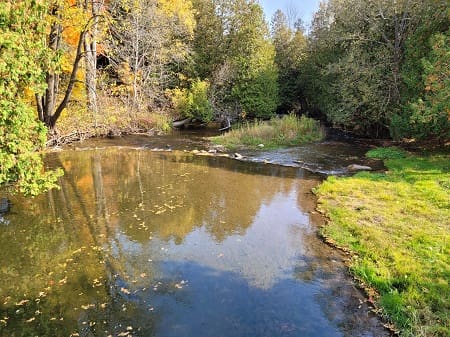
This is the core steelhead water on the Grand. It is a catch-and-release, artificial-lures-only section, and because the fish are not harvested here it has become a high-quality fishery. You get long runs, pools, and water that suits both swinging flies and float fishing, and clarity is generally better up here, especially after rain. Access is a little tighter than below Brantford because of private land, but the fishing quality is higher. This is ideal Spey and switch rod water, and a lot of experienced local anglers fish it in September and October before the Caledonia crowds show up. The best access points are the municipal parks in downtown Paris, Bean Park at the south end of Paris, and Brant Conservation Area near Brantford (entry fee).
2. Below The Caledonia Dam – The Main Concentration Point
The Caledonia Dam is the most obvious fish-concentration point on the lower Grand, and migrating steelhead pile up below it in mid-fall. The water below the dam at Kinsmen Park is the most well-known and most-fished steelhead spot on the lower river. Remember the 23-metre rule applies here. It gets heavily pressured in October and November, but later in November and through December the numbers hold while the pressure drops right off. One thing to know: clarity below Caledonia is poorer than upstream, especially after rain, because of the clay soils in Haldimand County.
3. York And The Caledonia-To-Cayuga Section
This stretch is some of the best Spey and swing water on the lower Grand. It is wide, it has good structure, and it takes far less pressure than the Caledonia Dam hole while still holding good numbers of fish. York and the water below the Caledonia dam are widely considered among the best steelhead spots in Haldimand County. York Park on Highway 54 is the key access point here.
4. Whitemans Creek – Tributary Steelhead
Whitemans Creek flows into the Grand between Paris and Brantford and is a significant steelhead tributary. Cold-water springs keep it suitable for migratory fish, and steelhead push up it to spawn, sometimes in trophy proportions. It is popular with fly fishers and gets real pressure in spring, and it works well for nymphing. Whitemans has its own special regulations that differ from the main river, so check the tributary-specific rules carefully before you fish it. Access is from several bridge crossings, and Lion’s Park on Maple Avenue in Burford is a reference point for the lower section.
Legal Public Access Points – Paris To Port Maitland
Most of the riverbank along the Grand is privately owned. The GRCA is clear that access is only available through GRCA property, municipal property, road rights-of-way, or with the landowner’s explicit permission, so do not assume you can get on at any random point along the bank. Many bridge crossings do have road allowances on either side that allow public access. Those are informal but legal, just make sure you are actually on the road allowance and not private land. One more note: Brant County brought in on-road parking restrictions at its river access points back in 2021, so check the current signage when you park at a Brant County site.
- Paris – Downtown Municipal Parks: Shore access from the municipal parks along the river in downtown Paris. This is the start of the Exceptional Waters Reach, which begins about 100 metres below the Hwy. 2 (Dundas Street West) bridge.
- Bean Park (Spencer Street, south end of Paris): River access at the south end of Paris and a good put-in or take-out for the Paris-to-Brantford section.
- Penman’s Dam (Willow Street, Paris): Landing dock and walkway on the east bank, and the portage point around the dam. Remember fishing is closed from Penman’s Dam to the William Street Bridge from October 1 to November 30.
- Brant Conservation Area (119 Jennings Road, Brantford): GRCA property with shore access and a gravel boat launch (Launch B) just outside the gate. Membership or entry fee required, and it is open May 1 to October 14 only. Wilkes Dam is inside the CA, so pull out above it at Launch B before portaging.
- Cockshutt Bridge (458 Erie Ave, Brantford): Non-motorized boat ramp with vehicle parking. A key put-in for the Brantford-to-Caledonia float, but plan your takeout at Kinsmen Park above the dam, because this section ends above the Caledonia Dam.
- Caledonia – Kinsmen Park, above dam (Caithness Street East): Pull out on the left bank above the Caledonia Dam, just upstream of the railway bridge. Portage point, and your takeout if you float down to Caledonia.
- Caledonia – Kinsmen Park, below dam (Caithness Street East): Shore fishing access below the Caledonia Dam, the most popular steelhead access point on the lower Grand, with an accessible fishing platform. The 23-metre rule applies from the dam structure.
- York Park (Highway 54 / Front Street, York): Just downstream of the York bridge on the east bank. One of the best steelhead access points in Haldimand County and a good base for the Caledonia-to-Cayuga water.
- Bob Baigent Memorial Park (Ouse Street, Cayuga): Public boat ramp downstream of the Hwy. 3 bridge on the east bank, with stores nearby. Good put-in or take-out for the Cayuga section.
- Byng Island Conservation Area (Dunnville): GRCA property with three concrete boat launches (admission or camping fee, no separate launch fee). To pass the Dunnville Dam by boat, follow the main channel of Sulphur Creek through the park back to the Grand. Do not run the dam. The Denil fishway is inside this CA.
- Wingfield Park (Main Street, Dunnville): Boat launch upriver of the Dunnville Dam on the town side, good access to the water above the dam.
- Dunnville Boat Club (Hydro Street, Dunnville): Boat launch immediately below the Dunnville Dam (launch fee applies). Your best access for fishing the lower river toward Port Maitland by boat.
- Port Maitland – River Mouth: Harbour and boat access where the Grand meets Lake Erie, with shoreline fishing at the harbour. A private marina (Maitland Shores Resort) provides boat access for guests. Most of the 30-plus kilometres between Dunnville and Port Maitland has almost no public bank access, so that stretch is really a boat game.
On-The-Ground Access And Parking (Map Links)
These are the specific spots and parking areas I use through the most productive water, from Paris down through Brantford to Caledonia. Each one links to Google Maps so you can pin it before you head out. Always check the current parking signage when you arrive, and remember that most of the Paris-to-Brantford water is the catch-and-release, artificial-lures-only Exceptional Waters Reach.
Paris
- Penman’s Dam Park – County Rd 51, Paris (Google Maps)
- Two Rivers Stadium – 2 Elm St, Brant, ON N3L 1L2 (Google Maps)
- Paris Optimist Park – 11 Catherine St, Brant, ON N3L 1B2 (Google Maps)
Brantford
- SC Johnson Trail – Powerline Rd Parking Area – 801 Powerline Rd, Brantford, ON N3L 4A2 (Google Maps)
- Oak Park Road Access – 72-82 Oak Park Rd, Brantford, ON N3V 0B1 (Google Maps)
- Gilkison Flats – Brantford, ON N3T 6H1 (Google Maps)
- SC Johnson Trail Parking – Brantford, ON N3T 5A8 (Google Maps)
- Wilkes Dam – 338 Dufferin Ave, Brantford, ON N3T 1K2 (Google Maps)
- Brant Park – SC Johnson Trail, Brantford, ON N3T 1K2 (Google Maps)
- Cockshutt Park – 35 Sherwood Dr, Brantford, ON N3T 1N3 (Google Maps)
- Cockshutt Bridge Access Point – 406 Erie Ave, Brantford, ON N3T 5L6 (Google Maps)
- Hamilton-Brantford Trail Access Parking – 166 Birkett Ln, Brantford, ON N3T 5L6 (Google Maps)
Caledonia
- Kinsmen Park (Caledonia Dam) – Kinsmen Park Trail, Caledonia, ON N3W 1B2 (Google Maps). The most popular steelhead access on the lower Grand, above and below the dam. Remember the 23-metre rule below the dam.
Drift Boat Sections
The Grand’s size makes it a great drift boat river through the lower steelhead zone, and several outfitters guide it by boat. The wide glides and long, deep pools are perfect for swinging flies, and a boat opens up less-pressured water that wade anglers just cannot reach. Here are the main runs.
- Section 1 – Brant Conservation Area to Cockshutt Bridge: Put in at Brant CA Launch B (open May 1 to October 14 only), take out at Cockshutt Bridge. No dams in this section. This is the Exceptional Waters Reach – catch-and-release, barbless, artificial only – and it is good Spey and swing water, manageable for both drifting and wading. Wilkes Dam is at the upstream end, so portage if you are coming from above.
- Section 2 – Cockshutt Bridge to Caledonia (above dam): Put in at Cockshutt Bridge, take out at Kinsmen Park above the dam. No dams within the section, and the river widens and deepens. You must take out above the dam – do not drift into the Caledonia Dam. Popular fall steelhead water.
- Section 3 – Caledonia (below dam) to York / Cayuga: Put in at Kinsmen Park below the dam, take out at York Park or Bob Baigent Park. No dams here. Wide and suited to a drift boat or small motorboat, and some of the best water on the river for swinging flies with less pressure than the dam hole. Clarity drops after rain due to the clay soils.
- Section 4 – Cayuga to Dunnville (above dam): Put in at Bob Baigent Park, take out at Wingfield Park or Byng Island CA. The river deepens and widens and gets more powerboat-friendly. Steelhead are here, but so are walleye, catfish, and bass. Ends at the Dunnville Dam – portage via the Byng Island Sulphur Creek channel or take out at Wingfield above the dam.
- Section 5 – Dunnville (below dam) to Port Maitland: Put in at the Dunnville Boat Club or Byng Island CA, take out at Port Maitland harbour. No dams. Very wide, slow, and turbid, and tough to read for steelhead – your best bet for reaching the lower river and the river mouth by boat. Check satellite imagery first, because the holding water is not obvious. Primarily a powerboat zone and excellent catfish and walleye water.
The Lower River – Brantford To Lake Erie
Below Brantford the Grand changes character in a hurry. It is over 100 feet wide in a lot of places and gets harder and harder to read on foot. You can still walk and wade from the bank access points, but a boat opens up a lot more water. Steelhead are spread all through the lower river in fall and spring, but the size and the turbidity, especially after rain, make them harder to target. The water below both the Brantford and the Dunnville dams is best fished from a boat. If you are going to fish this section, pull up satellite imagery beforehand to pick out the runs, pools, and transition zones, because a lot of the lower river is flat and featureless from the bank.
This is also where a wider set of methods really pays off. On these big, wide sections I do a lot of my fishing by covering water and getting bait or lures in front of fish that are spread out. A few approaches that consistently produce for me down here:
- Plunking is deadly on the big lower flats. You anchor a scented bait or a spin-n-glo on the bottom in a travel lane and let the fish come to you, which is perfect when the water is coloured and the fish are moving.
- Casting lures lets you cover a lot of featureless water quickly. Spinners, spoons, and crankbaits all take fish, and it is a great search method on wide runs.
- Back trolling and regular trolling from the boat let you work plugs and baits slowly through the deep pools and long glides that are common down here.
- Back bouncing bait through the deeper holding water from the boat is one of my favourite ways to pick apart the bigger pools in the lower river.
One clarity note for the lower river: it carries a lot of turbidity from the clay soils in Haldimand County, and after a rain the visibility below Caledonia can drop right off. When it is coloured, scent-based presentations like roe and scented beads will usually out-fish visual ones. Fall and early winter, before the prolonged rain events, give you the best clarity windows.
The River Mouth – Port Maitland
The Grand empties into Lake Erie at Port Maitland, near Dunnville. This is where steelhead first stage before they run the river, and where you will run into the freshest chrome the earliest in the season. Port Maitland gives you harbour access and shore fishing right at the mouth, and because the harbour connects straight to Lake Erie you can fish the mouth and run out to open water from the same launch. When river conditions are poor – too warm, too low, or too coloured – the early fish that have not pushed up yet will hold at and near the mouth.
Public access here is limited. The harbour is the main public spot, and the private Maitland Shores Resort marina serves its guests. That 30-kilometre stretch between Dunnville and Port Maitland is almost entirely private on both banks, so foot access is basically impossible except at the harbour and at Byng Island CA. For boat anglers, launching at the Dunnville Boat Club below the dam and running down to the mouth is the most practical approach. Keep in mind the lower river in Haldimand County (Lake Erie to the Caledonia Dam) has special regulations, so confirm the catch and possession limits for that zone first. And if you run out onto Lake Erie itself, you are into Fisheries Management Zone 19, which has different rules from the river (FMZ 16), so check both before your trip.
Methods And Gear For The Grand River
The Grand’s size, over 100 feet wide in many lower sections, suits a whole range of methods, from centrepin float fishing to Spey casting. Wide glides and long, deep runs reward anglers who like to cover water with a swing or a long drift. If you are not sure which approach fits you, my main steelhead fishing methods guide breaks them all down.
Float And Centerpin Fishing
This is the most popular method on the lower Grand. You suspend bait under a float anywhere from 2 to 12 feet down depending on the run, and it is deadly on the long, slow runs all through the lower river. Long rods give you much better mend control on wide water. My guides on float fishing for steelhead and centerpin fishing for steelhead cover the setups I use here.
Spey And Switch Rods
The Paris-to-Cayuga stretch is among the best Spey water in southern Ontario. The wide runs max out around 4 feet deep, so you do not need heavy sink tips. An 8 or 9 weight rod is about right given the size and the fighting strength of Grand River steelhead. This river rewards anglers who like to swing and cover water.
Single-Hand Fly Fishing
Single-hand fly gear works well in the Paris-to-Brantford Exceptional Waters, where the river is more manageable. Nymphing and indicator rigs are effective, and you can work the section well with a single-hand rod if you know where to wade. My page on fly fishing for Great Lakes steelhead covers the tactics and flies that my guide friends and I rely on.
Spin Fishing And Big-Water Methods
Spin fishing, float fishing, and drift fishing all produce, and long rods give you better control in big water. On the wide lower sections this is also where plunking, casting lures, back trolling, regular trolling, and back bouncing come into their own – I covered those in the lower river section above, and each one has a full guide on the site.
Proven Baits And Flies
There are a few baits I would not go to the Grand without:
- Roe: Roe bags and fresh skein are reliable year-round. Here is how I rig skein.
- Beads: 8 mm soft or hard plastic beads in natural egg colours are highly effective and one of the most-used presentations out here. See bead fishing for steelhead.
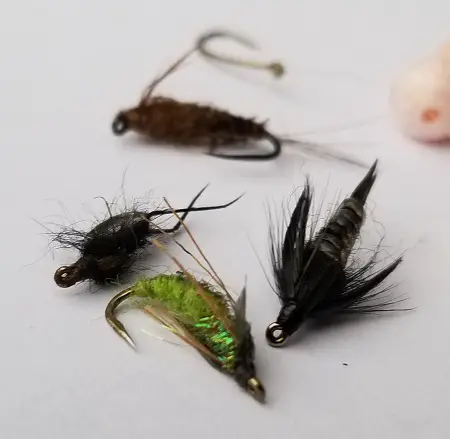
- Flies: Standard Great Lakes patterns all produce – pheasant tails, stonefly nymphs, Caddis larvae, egg patterns, Woolly Buggers, and egg-sucking leeches. For swinging, Spey and intruder-style flies shine in the larger, deeper runs.
- Worms: Live and plastic worms are excellent. One of my most effective baits here is the Raven pink or red worm.
For more on choosing bait and building rigs for this river, see my guides on the best steelhead bait and steelhead fishing rigs. One important gear note: in the Paris-to-Brantford Exceptional Waters Reach, only artificial lures are legal and only one barbless hook is permitted, so bait is not allowed in that section. Gear rules change between the upper regulated water and the lower river, so always confirm the rules for the exact section you plan to fish.
Fishing Regulations By River Section
The Grand is one of the most regulation-complex rivers in Ontario, and the rules change dramatically from section to section. Using the wrong rules for the wrong stretch is a common and costly mistake. Everything below is based on FMZ 16 and is only a summary – always confirm the current rules in the official Ontario Fishing Regulations for FMZ 16 before you fish, because they can change from year to year.
One rule to burn into your memory: a regulation that applies between Brantford and Paris does NOT apply between Brantford and Lake Erie. Always know which regulatory section you are standing in.
- Paris to Brantford – Exceptional Waters Reach: From 100 metres below the Hwy. 2 (Dundas Street West) bridge in Paris down to the pedestrian and service bridge just west of Brant Conservation Area in Brantford. Fish sanctuary (no fishing) from March 1 to the Friday before the fourth Saturday in April. Artificial lures only, one barbless hook only. During the sanctuary, walleye, smallmouth, pike, brown trout, and rainbow trout are all catch-and-release.
- Penman’s Dam to William Street Bridge, Paris – Fish Sanctuary: No fishing of any kind from October 1 to November 30, to protect the fall fish staging at the base of the dam.
- Brant CA service bridge to Lake Erie – Lower River: Brown trout and rainbow trout combined are one fish per day, no possession (S-1, C-0) from October 1 to December 31.
- Haldimand County – Lake Erie to Caledonia Dam: Special regulations apply, and the walleye rules here follow Lake Erie management rather than river management, so they differ from the rest of FMZ 16. Confirm the current rules for this specific section.
- Whitemans Creek – Tributary: Its own special rules – artificial lures and barbless hooks only in certain sections, a 50 cm minimum size for all trout, and sanctuary closures on portions (no fishing January 1 to the Friday before the fourth Saturday in April, and October 1 to December 31). These differ significantly from the main river, so read them carefully.
The 23-Metre Dam Rule – Province-Wide, No Exceptions
Under Ontario’s general regulations, it is illegal to fish in any manner within 23 metres (about 75 feet) downstream of any fishway, dam, or obstruction. This is a province-wide rule and it applies to every dam on the Grand, including Caledonia, Dunnville, Penman’s, and Wilkes. It matters here because the most popular steelhead spots are directly below the dams, where fish stack up and enforcement is highest. Measure from the downstream opening of the fishway, not the face of the dam, and fish beyond that line. There are no exceptions for method, species, or catch-and-release.
How To Find Fishing Reports And River Flows
It is hard to find steelhead reports for the Grand online, and a lot of guys are close-lipped about how the river is fishing. It is always best to fish after rains, as the river starts dropping and clearing. Depending on how much rain fell and the time of year, it can take 5 to 10 days for the river to clear.
What I do is watch the water-flow charts to see when the river goes from a good flow up to flood and back down again, and then I show up just as it is getting back to normal levels. You can check flows on the Grand River Conservation Authority website.
Fishing Maps For The Grand River
A good fishing map is a great way to start finding water on the Grand and to point yourself in the right direction when you do not know where to begin. Check out this GRCA fishing map when you want to find some steelhead water on the lower Grand.
Grand River Steelhead FAQ
Where is the best steelhead fishing on the Grand River?
The catch-and-release Paris-to-Brantford Exceptional Waters is the highest-quality water, the pool below the Caledonia Dam at Kinsmen Park is the most famous and most productive single spot, and the York-to-Cayuga stretch off Highway 54 gives you great swing water with less pressure.
When is the steelhead run on the Grand River?
Fish start entering in late September, the run peaks from mid-October through November after cold rains drop the water toward 60F, and good fishing continues through December until freeze-up. There is also a quieter spring season that opens after the fourth Saturday in April and runs into May.
How far up the Grand River do steelhead go?
Steelhead enter at Port Maitland on Lake Erie and run up to Penman’s Dam in Paris, which is the upstream barrier on the main stem. That is roughly 100 kilometres of fishable river. They cannot pass Penman’s Dam, so the water above Paris is a brown trout fishery, not a steelhead one.
Can you keep steelhead on the Grand River?
It depends on the section. The Paris-to-Brantford Exceptional Waters is catch-and-release. From the Brant CA bridge down to Lake Erie you may keep one rainbow or brown trout per day with no possession from October 1 to December 31. Always confirm the current limits for your exact section in the official Ontario regulations before keeping a fish.
Do you need a boat to fish the Grand River for steelhead?
No. There is excellent bank and wade access from Paris down through Caledonia and York. A boat helps on the wide lower river and is essentially required for the 30-plus kilometres between Dunnville and Port Maitland, where public bank access is almost nonexistent.
Sources
Grand River Conservation Authority (grandriver.ca), Ontario Fishing Regulations Summary for FMZ 16 and the General Regulations 23-metre fishway rule (ontario.ca), GRCA routes and access-point inventories, the Haldimand County Water Adventure and Fishing Guide, and my own years fishing and guiding this river. Regulations change annually – always verify the current rules at ontario.ca before fishing, and when in doubt contact the Ontario Ministry of Natural Resources.
Tight Lines,
Graham

To Trout & Steelhead,
On December 8-10 I visit Toronto to give a talk at University of Toronto, and I would like to fish for steelhead on December 11-12 near Toronto (lower Grand River?), unless it has become too cold at that time. Could I ask a few questions?
Do you offer guided tours at that time of the year?
If yes, would it be possible to make an arrangement, where I travelled by public transport from Toronto to some city near a decent river for steelhead fishing; one of your guides could picked me up there and return me to that spot after one day of steelhead fishing. Would that work for you? Which rivers and hub would you suggest?
What would the price be for such a day, including fishing permit?
Thanks for your time.
Sincerely
Leo Catana
Allégade 23C
2000 Frederiksberg, Copenhagen
Denmark
Hi Leo,
I will not be available to guide you this fall. I do list some great Ontario river guides on my page https://troutandsteelhead.net/river-fishing-guides . It’s best to contact them and see what they can offer you.
Good Luck
Graham
Hello Graham,
I’m going to the Grand River tomorrow to target Steelhead at the Caledonia dam. I’ve never fished there before so I was hoping you could give me some advice. Do I stick to the sides where it flows down or wade to the middle? I’m just not sure, really large area. Any tips would help.
Thanks,
Ryan
Hey Ryan,
Sorry for the delayed response, your question ended up in the spam box.
When heading to a new river, it’s best to learn to read the water, look for deep spots and edges, and fish everything that looks like it could hold a fish. Since they move around and since they get pressured in that area, sometimes you will find steelhead in small pockets and areas others are not fishing.
Good Luck.
Graham
Great information.
What size of steelhead is best for eating and roe producing
Hey Robert,
I really don’t consume a lot of steelhead but most of my buddies like to harvest steelhead in the 3 to 8 pound sizes and they much prefer fall and early winter steelhead that are fresh in from the lake over spring steelhead that are spawning or spawned out.
Best of luck
Graham
How far up the Grand do the steelhead travel?
Hey Andrew,
Last I heard, the steelhead make it up to the dam in Paris.
Graham